Skip Ribbon Commands
Skip to main content
Sign In

    Projects

    ​Enhancing Resource-Use Efficiency
    Smart Water and Nutrient Management for Greenhouse and Field Crops
    View Details
    ARS Project photo

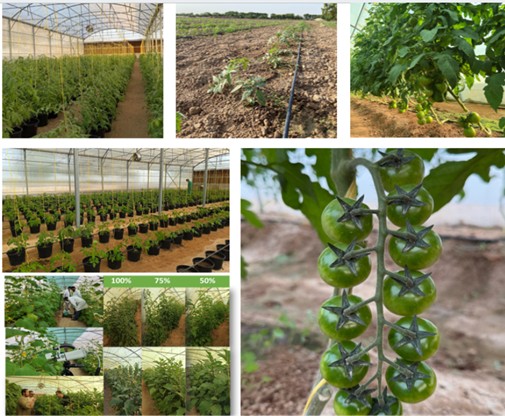
    Due to the lack of a well-coordinated communication mechanism among Qatari vegetable farmers, crop management practices vary significantly across farms. This makes farming operations highly inefficient in resource use. To minimize the economic and environmental impact of vegetable production systems, this project develops tailored water and nutrient management protocols for each crop/cultivar. Our initial results show that many crops can sustain yields with up to 25% less water.

    Specific objectives

    • Test across several vegetable crops in greenhouses under varying levels of irrigation
    • Develop AI- regulated fertigation systems for vegetable crops
    • Optimize irrigation schedules in progress for each crop/cultivar both for greenhouse field conditions
    From Imported Seeds to Local Solutions
    Building a National Platform for Climate - Resilient Vegetable Germplasm in Qatar
    View Details
    ARS Project photo

    Despite growing interest and commendable efforts to boost local food production toward self-sufficiency, particularly in vegetables, significant challenges persist in the local supply chain. These include seed sourcing, resource use efficiency, nutritional quality, and product shelf life. Seeds are the foundation of sustainable agriculture, carrying the genetic potential for high yields, nutritional value, and resilience to climate change, disease, and pests, directly impacting food availability, affordability, and stability. However, vegetable producers in the country heavily rely on imported seeds, not specifically bred for local climates, even for some of the most sought-after crops, including tomatoes. In addition, there is no centralized platform for systematic evaluation of imported germplasm, nor a coordinated pre-breeding program to inform future crop improvement strategies in Qatar. Given its strategic importance, the ARS at QU is working towards establishing a local germplasm screening and vegetable breeding program to support a sustainable production system in the country. A key early focus is identifying vegetable varieties that are best adapted to local conditions, particularly those combining high yield with efficient water use. So far, we have evaluated more than 230 tomato genotypes including breeding lines, cultivars, and landraces, sourced from different international organizations. These genotypes were tested both under open field and controlled environments (tunnels and multispan greenhouses) for their yield performance and produce quality. Ultimately, this work lays the foundation for a national, evidence-driven framework to evaluate, select, and improve vegetable germplasm for resilience, productivity, and resource-use efficiency under Qatar’s diverse production environments.

    Farmer Outreach and Community Engagement
    Linking Research with Local Farming Communities
    View Details
    ARS Project photo

    This initiative focuses on knowledge transfer to local farmers through surveys, training sessions, and field demonstrations. We also regularly engage with several local farmers understand needs of the local farmers.

    Specific objective

    • Completed baseline farming practices survey
    • Demo plots using saline water established (at Heenat Salma Farm)
    • Establishment of demonstration field plots at the Agricultural Research Station (ARS), Qatar University
    • Farmer field days and feedback-driven workshops
    Monitoring Growth, Health, and Stress Response of Cultivated Crops
    Tracks Plant Stress Behavior
    View Details
    ARS Project photo

    The Agricultural Research Station (ARS) at Qatar University is has recently purchased handheld leaf gas exchange analyzer system, LI-COR 6800, a modern tool for monitoring plant physiology i.e. photosynthesis, water use, and plant stress response in real time. This advanced technology allows our scientists to understand plant responses to environmental challenges such as drought, heat, salinity, and nutrient stress, supporting sustainable vegetable production in Qatar.

    At QU-ARS, we don’t just operate modern instruments, but we support data interpretation and assist with translating it into actionable insights. Whether for research collaboration, extension services, or public demonstrations, our LI-COR 6800 system allows us to showcase how science supports sustainable agriculture in Qatar.

    Crop Improvement for Climate Adaptation
    Resilient Crop Identification for Qatar
    View Details
    ARS Project photo

    We are evaluating a wide range of vegetable genotypes—tomato, cucumber, and eggplant—to identify cultivars that can withstand Qatar’s harsh environmental conditions. These genotypes are being assessed for their tolerance to heat, drought, and salinity, and high-performing genotypes will either be introduced directly to farming communities or used in breeding programs.

    Specific objectives

    • creen vegetable germplasm for biotic and abiotic stresses
    • Phenotyping of crop species to identify marker traits associated with stress tolerance
    • Establishing a breeding pipeline for future cultivars adopted to Qatari climate
    Optimizing Management Practices for Date Palm Yield and Quality Enhancement
    Enhanced Pollination Strategies
    View Details
    ARS Project photo

    This project focuses on improving the yield and quality of date palms by refining crop management techniques including irrigation, fertilization, and pollination strategies. Based on local climate adaptation, optimized practices have resulted in significant yield increases over the past few years.

    Specific objectives

    • Select optimal male-female cultivar combinations for higher pollination success
    • Develop new pollination methods for superior fruit formation
    • Enhance nutrient and irrigation regimes for yield improvement
    • Develop best practices for post-harvest handling and quality enhancement
    Genetic Diversity Asessment for Accelerated Breeding of Qatari Date Palms
    Uses Local Genomes to Speed Date Palm Improvement
    View Details
    ARS Project photo

    This initiative aims to transform the date palm industry in Qatar using cutting-edge genomics and breeding strategies. A plantation of over 800 date palms trees at ARS farm provides the core of a regionally important germplasm repository. In collaboration with the Center for Genomics and System Biology, New York University, this project aims to utilize this resource for studying genetic diversity of Qatari date palm germplasm. The project addresses key challenges to date palm industry, particularly climate change impacts, pests, and diseases. It aims to utilize region-specific genomic resources to accelerate date palm genomics improvement. The project findings will contribute to the development of date palm cultivars with high commercial value and pest resistance.

    Introduction of Climate-Resilient Crop Species
    Diversifying Qatari Agriculture with Stress-Tolerant Crops
    View Details
    ARS Project photo

    This program aims to introduce alternative crops e.g. asparagus, quinoa, barley, and sesame that are naturally adapted to arid and saline conditions. Extensive controlled environment and field trials are conducted using saline groundwater and seawater blends.

    Specific objectives

    • Optimize production practices for several newly introduced crop species in Qatar
    • Test crop performance under varying levels of salinity, drought and heat
    • Select suitable cultivars for field-scale cultivation
    • Ongoing trials with sesame for adaptability to Qatari soils.
    Asparagus Cultivation in Qatar
    A Practical Model for Sustainable Agriculture Under Arid Conditions
    View Details
    ARS Project photo

    Qatar is making significant and confident strides in the field of sustainable and good agricultural practices every day. Due to its challenging climatic conditions, implementing sustainable agriculture presents a unique set of opportunities and obstacles. As the ARS under the umbrella of Qatar University, we continue to work steadily towards sustainable and good agricultural practices everyday. One of our key projects is the cultivation of Asparagus officinalis, which began 14 months ago and has been successfully produced ever since. We germinated Spanish-origin asparagus seeds in our nursery and initiated trial production with 120 plants in a soil-based area shaded with green netting, where growth and production continue successfully.

    During production, we observed how Qatar's harsh climatic conditions, particularly during summer, can be leveraged by balancing the generative and vegetative growth of the asparagus plant. Over a period of 14 months, each plant produced an average of 18–25 shoots, with individual weights ranging from 10 to 40 grams depending on plant age. No pesticides or acaricides were applied, as local pests appeared unfamiliar with the crop. In addition, the plant’s low water and fertilizer requirements, directly proportional to its growth, contribute significantly to its suitability for local conditions. With its rich nutritional profile, ease of cultivation, and adaptability to the climate, asparagus shows strong potential as a viable alternative crop for farms and markets in Qatar.

    Vertical Farm
    Resource Efficient Smart Farming Practices
    View Details
    ARS Project photo

    The Agricultural Research Station works diligently to provide innovative scientific solutions to various challenges facing the Qatari agricultural sector. Recently, the station developed Vertical Farming Technology, a patented hydroponic vegetable cultivation system in a facility for fresh leafy vegetables. Vertical farming offers a host of benefits. It allows for year-round production, ensuring a consistent supply of leafy greens regardless of external factors like weather and seasons. This approach also leads to reduced resource usage, as controlled environments cut water consumption by up to 90% when compared to traditional farming, while energy-efficient LED lighting minimizes electricity consumption. Additionally, vertical farming contributes to a smaller carbon footprint by being located closer to urban areas, which reduces transportation emissions, and by employing controlled environments that lessen the need for chemical inputs. The Qatar University Vegetable Factory (QUVF) is well equipped with precise climate control systems that regulate temperature, humidity, CO2 levels and lighting to replicate the ideal conditions for each leafy vegetable species. The research team is currently working on adapting and developing project ideas to fit the Qatari environmental conditions, particularly in terms of cooling systems and energy supplies, in collaboration with researchers from Qatar University in these fields. This project is expected to open new research horizons for various disciplines within and outside of Qatar University, offering new training and research opportunities for students. Additionally, it is anticipated that the project will provide a domestically produced product that supports the local market.

    Specific Objectives

    • Enhance growth using tailored LED light spectra
    • Enable year-round production independent of weather
    • Automate real-time monitoring and adjustments
    • Maximize resource efficiency (water, energy, nutrients)
    • Increase yield and quality of leafy vegetables
    • Serve as research platform for agritech innovation
    Biofortification
    Use of Green Synthesized Selenium Nanoparticles Improving Nutritional Quality of Vegetables
    View Details
    ARS Project photo

    Advancements in sustainable nanotechnology have paved the way for innovative agricultural solutions. This project explores the green synthesis of selenium nanoparticles (SeNPs) using tomato extracts, focusing on bio-fabrication mechanisms, yield optimization, and characterization methods. The process commenced with the extraction of bioactive compounds from tomato waste, followed by synthesis of SeNPs through a controlled reaction with sodium selenite. Characterization techniques such as UV-Vis spectroscopy, FTIR, SEM/EDX, TEM, zeta potential, and DLS confirmed the formation and properties of SeNPs. The analysis also indicated the presence of various functional groups of phytoconstituents from tomato extract that suggested to be responsible for reduction and stabilization of SeNPs, thereby playing a pivotal role in their synthesis. The agricultural application of SeNPs involved their foliar administration to lettuce crops, cultivated hydroponically for over 30 days. Results demonstrated significant improvements in plant biomass, with the optimum treatment showing enhanced growth metrics, such as increased fresh weight and dry weight. Additionally, it highlights the use of SeNPs as a foliar treatment to enhance hydroponic lettuce growth, showcasing their potential for sustainable agriculture in arid regions like Qatar.

    Specific Objectives

    • To investigate the effect of different parameters on synthesizing SeNPs using S. lycopersicum extract.
    • To study the chemical and physical characteristics of SeNPs.
    • To examine the agronomic impact of SeNPs on leafy vegetables grown in hydroponic media.
    Sensor-Driven and AI-Powered Crop Monitoring
    Enhanced Efficiency Strategies for Controlled Environments
    View Details
    ARS Project photo

    In collaboration with the College of Engineering, Qatar University, we use smart technologies to improve greenhouse efficiency. LED light trials for vertical farming and AI-based crop monitoring platforms are under development.

    Specific Objectives

    • Pilot trials of AI-based crop monitoring systems in greenhouses
    • Optimize light spectrum (red/blue) and nutritional requirements of leafy vegetables
    • Test innovative techniques to improve the nutritional quality of the lettuce crop
    • Develop and test the performance of a lab-scale vertical farm
    Sustainable Beekeeping, Production, and Optimization of High-Quality Honey
    Organic Certification Sustainability
    View Details
    ARS Project photo

    ARS has established its own apiary unit at our agricultural farm to demonstrate commercial honey and other bee products production, as well as to conduct research on sustainable beekeeping, local honey, propolis, and pollen. Moreover, our research focuses on optimizing honey processing to improve the yield and quality of local honey, ensuring high-quality, innovative, health-promoting products.

    Specific Objectives

    • Preserve and enhance bioactives in honey.
    • Development of eco-friendly practices to maintain organic certification.
    • Training and services for promoting local beekeeping
    • Focus on bee health and environmental impact
    Study of Polyphenol Markers in Qatari Honey and Propolis
    Evaluation of Their Nutraceutical Properties
    View Details
    ARS Project photo

    Qatar has a unique floral biodiversity that mainly comprises flowering plants. However, little is known about the nectar and honeydew contributors to Qatari honey. The limited available flora and seasonal variation in flora around beehives make beekeeping challenging in Qatar. Therefore, understanding the seasonal impact on local honey production, including the production of high-quality honey, is crucial for sustainable beekeeping in the country. Our research aims to identify polyphenol markers of the botanical origin of Qatari honey and propolis, as well as explore the nutraceutical potential of them in conjunction with their phytochemistry and bioactivities.

    Specific Objectives

    • Provide key insights on chemistry and health benefits of locally sourced honey.
    • Enhance understanding about the chemistry of Qatari propolis.
    • Support the scientific promotion of indigenous and sustainable local beekeeping practices.
    • Highlight both the opportunities and challenges facing beekeeping in Qatar’s unique environmental context.
    Resolving Taxonomic Ambiguity in Qatari Pulicaria Species
    Evaluating Their Food and Medicinal Applications
    View Details
    ARS Project photo

    In Qatar, three main Pulicaria species (Pulicaria undulata (L.) C.A.Mey., Pulicaria sicula (L.) Moris, and Pulicaria gnaphalodes (Vent.) Boiss.) are reported, which have significant potential for food and medicinal applications due to their bioactive compounds. However, these species have considerable taxonomic ambiguities due to their morphological resemblances, including the presence of sub-species. This raises questions about their reported diversity and distribution in Qatar, as well as their sustainable use. Therefore, this research aims to resolve the taxonomic ambiguities of Qatari Pulicaria species using a metabolomics approach, and to remap their biodiversity and distribution, including achieving their conservation and sustainable use.

    Specific Objectives

    • Chemically distinguish three Qatari Pulicaria using untargeted HPLC-MS approaches.
    • Understand the species closeness based on chemotaxonomy.
    • Remap the biodiversity and distribution of Qatari Pulicaria species.
    Potential of Qatari Pulicaria Natural Fibers in Biomedical Applications
    Boost Qatar’s Bio‑Based Economy
    View Details
    ARS Project photo

    In our previous study, for the first time, we extracted and characterized natural fibers, from two Pulicaria species, Pulicaria undulata (L.) C.A.Mey., and Pulicaria gnaphalodes (Vent.) Boiss, and showed that raw Pulicaria fibers are lignocellulosic in nature, and possess promising antioxidant activities. Furthermore, P. undulata fibers were also found to have remarkable antifungal activity against Candida albicans, a major contributor to candidiasis. Together, these findings highlight the potential application of these fibers, especially P. undulata as powerful biomaterials for wound healing and other medical and cosmetic applications. However, in a similar study, it has also been found that common chemical treatments such as alkali treatments, which are given to raw natural fibers to improve their functionality of fibers, removed a significant portion of bioactive extractives from the raw Pulicaria fibers, thereby reducing their intrinsic biofunctional properties. Hence, in our ongoing research, we are extracting fiber bioactive extractives from these fibers and incorporating them into other natural fibers for developing advanced natural fibers for biomedical applications.

    Specific Objectives

    • Generate comprehensive report on the chemistry of Publicaria fiber extractives.
    • Develop a novel, natural, and green biomaterial for wound healing.
    • Contribute to the local Qatari biobased economy through novel product development.
    Standardization and Validation of Extracts of Qatari Pulicaria Species
    Their Applications in Treating Metabolic Diseases
    View Details
    ARS Project photo

    Under this project, various extracts of different Pulicaria species are being chemically characterized and standardized using HPLC-QTOF-MS. Subsequently, potential applications of these extracts in treating diabetics and managing its complications are being evaluated in pre-clinical Drosophila model

    Specific Objectives

    • Chemically standardize various extracts of different Pulicaria species for their future applications as drugs or health supplements.
    • Identifying promising antidiabetic compounds in different extracts of Pulicaria species.
    • Validate traditional claims regarding uses of Pulicaria species in treating.